Ventilation, Heat and Extraction: The Overlooked Cost of Chargrilling
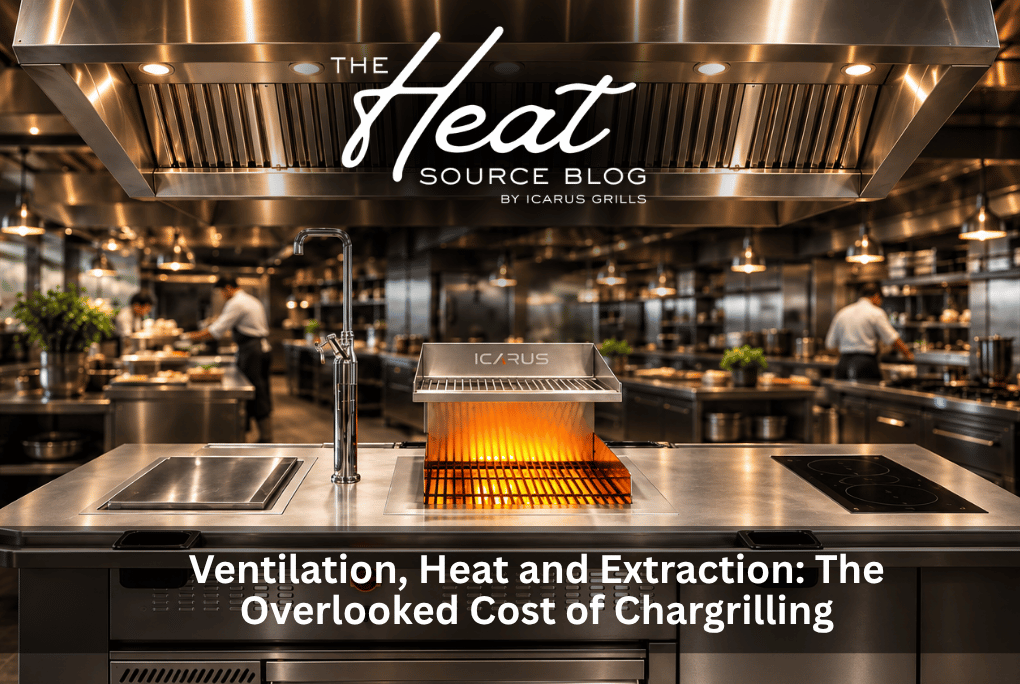
When operators compare commercial chargrills, the conversation usually starts with the grill itself. How quickly does it heat up? How much food can it handle? What kind of sear does it produce? How much does it cost to run?
But the appliance is only part of the equation - Traditional charcoal and solid-fuel cooking can have a much wider impact on a commercial kitchen — affecting extraction, replacement air, kitchen temperature, maintenance, fire safety and even the working environment experienced by the brigade.
For UK operators considering a new chargrill, refurbishment or move towards an all-electric kitchen, it is therefore worth looking beyond the purchase price of the appliance.
Because sometimes the biggest cost of charcoal isn't the charcoal itself.
Extraction Isn't Just About Removing Smoke
Commercial kitchen extraction performs several jobs simultaneously.
The Health and Safety Executive states that catering and cooking can generate significant amounts of fumes, vapours and heat. An effective ventilation system should remove cooking fumes at source, remove excess hot air, introduce clean replacement air and create a safe and comfortable working environment. HSE
In most professional kitchens this means a mechanical extraction system incorporating a canopy, filters, ductwork and fan system.
And importantly, extraction shouldn't be considered independently of the equipment underneath it.
HSE guidance says ventilation design should take account of the cooking load, amount of equipment, kitchen layout, number of staff and maintenance requirements, while the extraction rate should ideally be calculated using information supplied for the appliances themselves. HSE
In the UK, BESA DW/172 is widely recognised as the key industry specification for commercial kitchen ventilation design, installation and maintenance. The current second edition also includes dedicated guidance covering solid-fuel appliances and demand-controlled kitchen ventilation. BESA Publications
So choosing a cooking appliance can influence considerably more than the equipment schedule.
It can influence the mechanical services around it too.
Solid Fuel Adds Another Layer
Charcoal brings a particular set of considerations because the kitchen isn't only extracting the products created by cooking.
It is also dealing with the products created by combustion.
When solid fuel burns it produces carbon monoxide. HSE specifically identifies charcoal grills, tandoori ovens and wood-fired pizza ovens as appliances where employers need to manage the potential risk of carbon-monoxide exposure. HSE
That changes the ventilation conversation.
Fresh-air supply becomes critical. The extraction system must safely capture and discharge combustion products, and HSE advises operators considering solid-fuel equipment to seek competent advice covering installation, ventilation, extraction and maintenance. HSE
There are also considerations that continue beyond the cooking period.
Unlike an electric appliance that can simply be switched off, charcoal can continue producing combustion products while it cools. HSE specifically notes that adequate ventilation may still be necessary overnight while charcoal equipment is cooling in order to prevent carbon monoxide accumulating. HSE
That is an important distinction when thinking about the true operating cost of a solid-fuel kitchen.
The grill may have stopped cooking.
The ventilation requirements haven't necessarily stopped with it.
Carbon Monoxide Monitoring and Safety
There are further responsibilities surrounding solid fuel.
HSE guidance recommends a functioning audible carbon-monoxide alarm suitable for commercial kitchens, together with appropriate emergency procedures. It also advises that extraction should continue operating until all solid fuel has been extinguished. HSE
If a ventilation fan is required to continue operating beyond service, that means energy is still being consumed even though the restaurant may no longer be generating revenue.
Taken individually these considerations can seem relatively small.
Taken across hundreds of operating days each year, they form part of the wider economics of the cooking system.
Then There Is the Heat
Anyone who has worked a busy service around a traditional chargrill knows just how much heat can enter the kitchen.
Some heat is captured by the extraction system.
Some isn't.
And radiant heat from high-temperature equipment contributes directly to the environment around the chef.
This matters for more than comfort.
HSE specifically warns that inadequate ventilation can contribute to heat stress and lethargy, potentially affecting safe working practices and staff retention. HSE
For an operator, excessive heat may ultimately result in additional cooling requirements elsewhere within the kitchen.
The hotter the cooking environment becomes, the harder ventilation and cooling systems may have to work to maintain reasonable conditions.
That means the true energy picture of a chargrill isn't necessarily represented by its fuel bill alone.
You also need to consider the building around it.
Every Cubic Metre Extracted Has to Come From Somewhere
One of the most easily overlooked aspects of commercial kitchen ventilation is replacement air.
If large quantities of hot kitchen air are being extracted from a building, air needs to replace it.
HSE guidance specifically requires ventilation design to consider this make-up air. In larger kitchens, this will often involve mechanical supply using fans and filtration. HSE
That incoming air can also require conditioning.
During winter it may need heating.
During summer it may contribute to the cooling challenge.
There are therefore several potential energy consumers operating around a high-output cooking appliance:
the appliance itself, the extract fan, the supply-air system and potentially the heating or cooling required to condition that replacement air.
This is why looking purely at the energy consumption of the cooking appliance can provide an incomplete picture.
Kitchen efficiency needs to be considered as a system.
Extraction Can Influence the Building Itself
There are practical implications too.
A higher-demand ventilation system can mean larger ductwork, greater fan capacity, more substantial canopy arrangements and potentially more complicated routes through a building.
In a new-build restaurant these requirements can be incorporated into the design.
In an existing building they can become considerably more challenging.
Hotels, listed buildings, shopping centres, high-rise developments and city-centre restaurants can all present restrictions around duct routes and external discharge locations.
This is one reason equipment selection is increasingly becoming a conversation involving not simply the chef and equipment dealer but kitchen designers, M&E consultants, ventilation specialists and architects.
The cooking technology influences the infrastructure.
Cleaning, Grease and Fire Risk
Extraction systems don't disappear once they have been installed.
They need maintaining.
Cooking fumes can deposit grease within filters, canopies and ductwork, which is why HSE requires ventilation systems to be designed with suitable access for cleaning and maintenance. Accumulated grease can reduce system efficiency and increase fire risk. HSE
Solid-fuel installations create additional responsibilities.
HSE guidance states that extraction systems serving commercial solid-fuel appliances must be thoroughly examined and tested at least every 14 months, alongside an appropriate regular cleaning and maintenance programme. HSE
Again, these are not arguments against charcoal.
They are simply part of understanding its complete operating environment.
So What Changes When the Chargrill Becomes Electric?
Moving from charcoal to electric doesn't make ventilation disappear.
That is an important point.
Food being grilled still produces heat, grease, vapour, smoke and cooking odours, so an electric chargrill will still normally require appropriately designed commercial kitchen extraction.
What changes is the nature of what the ventilation system has to deal with.
An electric chargrill is not burning charcoal as its energy source, so the extraction system is no longer dealing with carbon monoxide and combustion products generated from solid fuel.
There is no smouldering charcoal remaining after service.
There is no solid fuel that needs to continue being ventilated until fully extinguished.
There is no charcoal storage or ash disposal.
And there is no requirement to manage combustion air for the grill itself.
That distinction can potentially simplify kitchen design and operation, although actual ventilation requirements must always be calculated for the specific appliance, menu, canopy and building by a competent ventilation professional.
Where Icarus Fits Into the Picture
This is one of the reasons electric chargrilling technology has become increasingly interesting to commercial kitchen operators.
The challenge has traditionally been performance.
Chefs like charcoal because of what it does.
The intense radiant heat. The aggressive searing. The caramelisation. The flames created as fats and juices interact with the heat source.
Replacing that with a conventional electric grill could mean losing many of the characteristics that made the chargrill valuable in the first place.
Icarus has been developed specifically to address that problem.
Rather than simply providing another electrically heated cooking surface, the Icarus PRO system has been engineered to mimic the characteristics of hard-fuel cooking using high-intensity electric heat.
The Icarus Heat System reaches temperatures above 500°C, providing the penetrating heat required for high-temperature searing and chargrilling without using gas or solid fuel. Icarus Grills
The current 600 PRO uses two internal Icarus SGR heating elements with a maximum electrical input of 8.64kW, while the larger 900 PRO uses three elements and is rated at 12.96kW at full power. Both incorporate an insulated refractory hearth and heavy-duty commercial stainless-steel construction. Icarus Grills
The intention is simple:
retain the high-temperature grilling experience while removing solid fuel from the equation.
Less About Removing Extraction — More About Rethinking It
This is an important distinction.
Icarus shouldn't be viewed as an "extraction-free" grill.
It isn't.
Professional grilling still creates cooking fumes and heat, and UK commercial kitchens still need ventilation designed around their actual cooking load.
The opportunity instead lies in removing some of the additional considerations associated specifically with burning solid fuel.
That may potentially allow an operator, kitchen designer or M&E consultant to approach the ventilation strategy differently.
Indeed, when Icarus was introduced to the UK market, Pro Foodservice Reps highlighted the elimination of gas and charcoal as one factor that can simplify kitchen operation and potentially reduce ventilation requirements, subject of course to the design and conditions of the individual kitchen. Icarus Grills
That's a much more useful way of looking at the technology.
Not:
"Do I still need extraction?"
But:
"What does my extraction system actually need to handle?"
The Royal Foresters: Replacing Coal with Electric
One real-world example can be found at The Royal Foresters in Ascot, where an Icarus 900 PRO replaced a traditional coal-fired oven within the venue's open kitchen.
The objective wasn't simply to reduce energy consumption.
The new equipment also had to maintain the high-temperature cooking performance and visual theatre expected from an open kitchen.
According to our case study, the venue expected utility savings of more than 70% following the switch while retaining the grilling performance required by the operation.
Perhaps equally interesting from a kitchen-design perspective is what has disappeared from the equation.
No coal.
No solid-fuel storage.
No ash.
No combustion generated by the cooking fuel.
That can have implications far beyond the grill itself.
The Bigger Question for Operators
When specifying a chargrill, it therefore makes sense to ask more than:
How much does this appliance cost to run?
Operators should also consider:
What extraction rate will the cooking process require?
How much replacement air will the kitchen need?
Does that replacement air require heating or cooling?
What additional heat will be introduced into the working environment?
What cleaning and maintenance programme will the extraction system require?
Are combustion gases being produced?
Will extraction need to operate after the kitchen closes?
What monitoring and safety systems are necessary?
How will the system affect the wider M&E design of the building?
Those questions help move the conversation from appliance efficiency to kitchen efficiency.
And that is increasingly where some of the biggest opportunities can be found.
Looking Beyond the Grill
Charcoal will continue to have a place in professional kitchens.
For some restaurant concepts, solid fuel is an integral part of their identity and cooking philosophy.
But operators should understand everything that comes with it.
Extraction, heat, make-up air, maintenance, fuel storage, carbon-monoxide management and the wider effect on kitchen working conditions all form part of the true cost of traditional chargrilling.
Electric technology is now providing another option.
With Icarus, chefs can access the intense heat, searing, flavour and theatre associated with chargrilling while removing the requirement for charcoal or gas as the primary energy source. Icarus Grills
And when the entire kitchen — not just the individual appliance — is taken into account, that can become a much bigger conversation than simply electricity versus charcoal.
Rethink the Heat
If you're designing a new kitchen, refurbishing an existing operation or investigating the move from solid fuel to electric chargrilling, speak to the Icarus team about your application.
Discover Icarus Electric Chargrills and book a demonstration to experience the heat and performance for yourself.
Icarus — all the flavour and theatre of chargrilling, without the solid fuel.